Showing posts with label 2600. Show all posts

Sunday, January 24, 2016

Berzerk - Atari VCS/2600


When Nolan Bushnell and Ted Dabney built their first arcade game, Computer Space, (released just a couple months after similar game Galaxy Game) one of the major bits of feedback they received was that it was simply too complex of a game for people to walk up and play, prompting them to refocus on making simpler games, Al Alcorn's Pong being the first result from this change in philosophy and a major hit.

Computer Space
What sometimes gets lost in this history is the shared lineage of these games in the minicomputer revolution of the 60's. It's inevitable as minds get to know the rules of any system to want to start to explore the boundaries of that system and this turns rapidly into play. In computing, bored academic researchers figured out how to hook a display up to a PDP-1 and quickly started making games -- one of the first was Spacewar. 

Space War
Bushnell and Dabney's genius was not in inventing a space shooter, they didn't, but in figuring out how to replicate the basics of the game cheap enough to make it have a commercial chance. Galaxy Game, in comparison, used the same expensive minicomputer hardware found in the academic research setting, ensuring the games could never pay for themselves and thus not be commercial viable. 
Tennis for Two
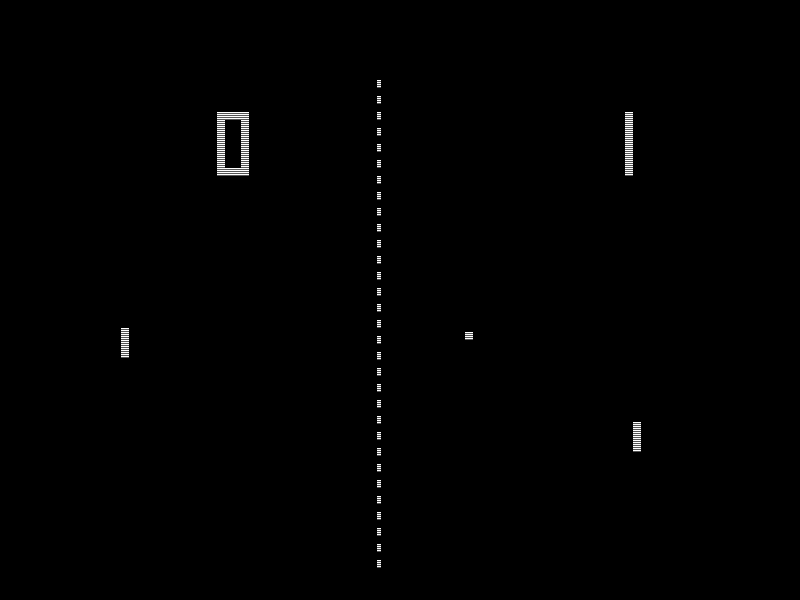
Bushnell and Alcorn's later Pong repeated this pattern by adopting William Higinbotham's 1958 Tennis for Two to fit into cheap, commercial deployable hardware. Combined with the lessons learned about complex controls from Computer Space, turned Pong into a tremendously successful and highly influential game, launching Atari into the stratosphere and kickstarting the entire commercial video game industry.
Pong
It didn't take long for this new industry to see a pattern: look at the world of academic research computing, boil the game down to basics, implement in cheap hardware and enjoy buckets full of quarters. 

It turns out that academic computing was full of these little experimental games. On early Unix systems a game simply called Robots was a minor side project by programmer Ken Arnold (better known as the creator of Rogue which spawned its own entire genre of games that still exists to this day).

BSD Robots

Robots has its own complicated history full of clones and copies. But one thing that defines it as a game is the turn-based strategy nature of the gameplay. The player can sit and deliberate over their next move as long as they wish, while enemy mines/robots slowly vector in towards the player. The game is frightfully hard, and also nearly ubiquitous on early Unix-like systems.

And so it turns out that Alan McNeil, an employee of Chicago based Stern Electronics, almost definitely had contact with the game at some point. When Stern decided to enter the new arcade video game market, in addition to its earlier pinball games, they put McNeil in charge of designing and building a game. 

Alan McNeil
McNeil, crediting a bad dream he had about being chased around by robots, made liberal use of Robots basic design. However he turned the game on its head. Robots is at its heart a defensive game, you move about the game screen trying to cause enemy robots to collide with themselves or obstacles scattered around the screen. McNeil, correctly sensing that this wouldn't appeal to the kind of walk-up game play needed for arcade games, armed the player with a weapon. He then expanded the obstacles into a cursory maze, got rid of some of the extra player verbs (that would have required extra buttons and controls), added some speech and finally made the game real-time instead of turn-based.

These changes, as it turns out, where just what the arcade scene needed and Bezerk was born. It hit the arcades at the end of 1980 and was an immediate hit. It's not hard to see why.


Bezerk makes the player feel like the most dangerous thing in the room. The robots are trapped in the maze with you, not the other way around. You can maneuver better than they do, fire faster and use strategies to clear the room. The robots are powerful only in numbers, but they're fairly dumb -- a valid strategy is often to trick them into walking into maze walls (which will kill you also). If you take too long, a bouncing smiley face called Evil Otto will come out and "encourage" you to move on. This keeps the game active and leaves the player with precious little time between waves of robots.

Other strategies might involve shooting enemy fire right out of the air, taking cover behind maze walls causing Otto to collide with enemy robots. In a nod back to Robots, the enemy robots will die if they collide with each other. Virtuoso players play the game aggressively and trade laser fire readily with their enemies. 

Despite the lower resolution, Bezerk survives the transition to the VCS/2600 surprisingly well. This is the version I remember the best, and the sounds of the player dying still send a chill up the back of my neck. The robots can often be brutal, pumping the players electrified body full of laser shot well after death.

Bezerk for the 2600 wasn't released till 1982, a couple years after the arcade release, but the distillation of the controls down to a single button maps well to the 2600's controller. The lower resolution adds a little bit of claustrophobia to the game, though occasionally can make it feel a little cramped. It also loses the voices and diagonal shot take off at a weirdly horizontal bias making learning their angle key to success.

But these are very mild complaints, the game is fantastic, even today. It's still played competitively. The modern retro gaming movement has breathed some new life into it. Bezerk has a long legacy: Robotron 2084, Smash TV, Geometry Wars, Dead Nation, and so on. And modern gamers raised on these progeny are finding new appeal in the purity of the game design. Berzerk is not just a great game for the 2600, it's a great game today and feels surprisingly modern. It was followed by a lesser known, but no less great, sequel called Frenzy, which features several upgrades to the sparse play mechanics of Berzerk.
Tuesday, October 28, 2014

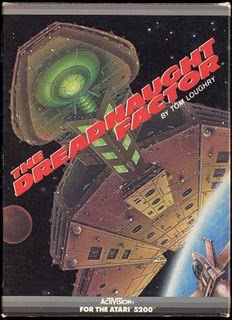
The Dreadnaught Factor - Atari 5200

The night before Christmas my cousins and I built a fortress of presents under our fake Christmas tree and lay under the plastic needles looking up at the whirl of blinking colored lights and tinsel. Protected by our formidable barrier of merriment, no adults dared come into the family room. Thus isolated, we were free to try and discern what gifts we would be getting that year. One huge box with my name on it had me transfixed all evening. The anticipation had grown so strong that our parents, unable to get us to bed, had allowed us each to open two presents.

The first was that box of mysteries, which turned out to be an Atari 5200. My second present (opened at my Grandmother's subtle hint) was The Dreadnaught Factor. This negotiated arrangement concluded, our parents finally got us into some kind of horizontal laying position, in sleeping bags under the tree in the remains of our assaulted holiday stronghold. Sleep escaped us and by two in the morning we had figured out how to hook the Atari up to the family television and we started to play until exhaustion and hunger wiped us out late the next evening.

Before the 5200 our combined video game playing experience consisted of time playing arcade games, my neighbor's Atari VCS/2600 and some home computer games on some of the various 8-bits of the time. Nothing we had experienced to that point prepared us for this game.

Star Wars still hung huge in the public consciousness, but the arcade had failed to provide an interactive experience as cinematic, as awesome as the movies (the arcade Star Wars hadn't yet been released). The closest experience by Christmas 1982 was probably Parker Bothers' Star Wars: The Empire Strikes Back (SW:TESB) for the Atari VCS/2600 which tried to replicate the Battle of Hoth.


SW:TESB blew my child-like mind when I first played it at a friend's house. The battle it recreates is one of the most iconic scenes in movie history. But the game ultimately disappointed me when I couldn't grapple and trip the legs of an AT-AT and the rest of the gameplay just turned into a competition of how many times I could hit the fire button while zooming left and right. There simply wasn't much there there, even young me caught onto that.

It's hard to trace back the history of the idea of a "Boss Rush" in video games, but SW:TESB might be close to the origins though the term hadn't been coined yet. You really only ever fight what we'd think of today as bosses, AT-ATs. 

In this Star Wars environment, The Dreadnaught Factor (TDF) took a different spin on the idea. Instead of a horizontal shooter,  TDF on the Atari 5200 is a vertical shmup (the port for the Intellivision is basically the same game in a horizontal format) built entirely around the boss rush.

Just like other contemporary vertical shmups, you pilot a lone fighter craft. Unlike all those shmups however, you never really fight other enemy fighters, you fight huge multi-screen spanning Star Wars Star Destroyer like "Dreadnaughts". 


In 1983 this was unbelievably innovative as a game, unbelievably derivative of Star Wars, and freaking awesome. It probably wasn't until Shadow of the Colossus on the PS2, 22 years later, that a similarly cinematic David and Goliath game set you up with odds so tilted against your favor. 

TDF does some things amazingly well, full-screen multi-directional scrolling (something the NES struggled with early on), tons of targets, a countdown clock that built up tension as the game progressed and more.

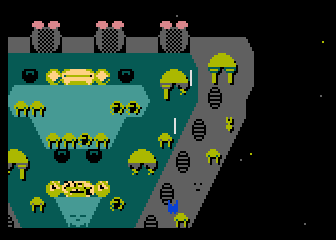
You strafe a giant dreadnaught, picking off cannons, missile launchers, engines and other targets -- and this is important, the damage you do to the dreadnaught is real. You take out the engines, it slows its descent towards Earth, you take out the bridge and it's limited in how it can coordinate defensive fire. These aren't just symbolic target points. You measurably impact and frustrate the enemy's ability to attack. The goal, borrowed again from Star Wars, is to plug up all the vents on the surface of the ship by bombing them, causing the ship's power system to overload and blow up.

In structure it's also a bit of a riff on the 1980's Missile Command. In Missile Command your view is on the entire battlefield and the contact between your defense missiles and the in-bound enemy ICBMs is abstract. In TDF, you are the missile in essence. The feeling of being overwhelmed and under attack is still there. Where Missile Command is a strategic game, TDF is purely tactical. You don't just send up a defense and pray to the fates for salvation. You are the direct instrument, the tip of the spear between the invaders and oblivion.


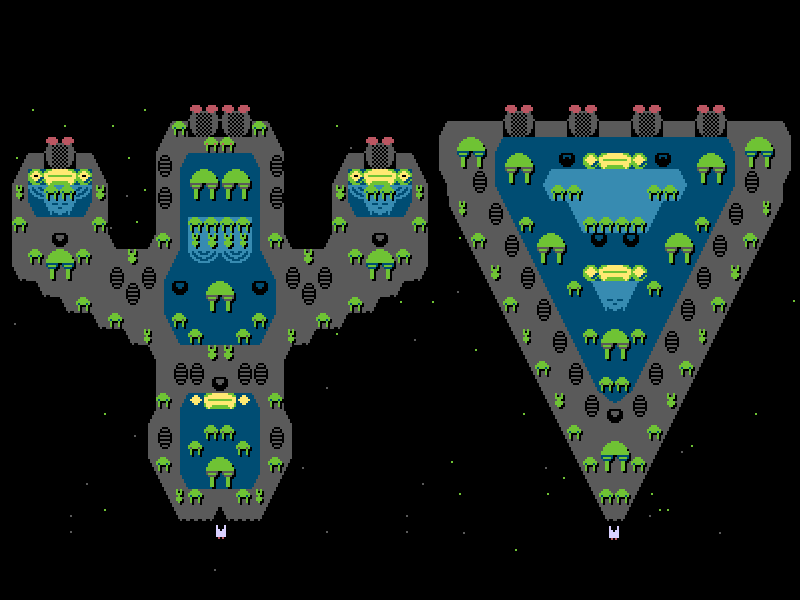
To cement the Star Wars influence, the first dreadnaught you encounter is about as close of a carbon copy to a Star Destroyer as could reasonably be rendered in 8 glorious bits. The triangular shape instantly recalls those unstoppable flexions of emperial power and cues you into what you're supposed to do, fight it! If the Rebels could do it, you can!


TDF runs with the idea and you start fighting ships of all kinds of layouts. And of course they get more and more aggressive as you go, guns fire more often and more accurately, missiles launch more quickly, etc. Before you launch each fighter, you get a proximity view that lets you know how close the dreadnaught of the level is to firing range to the Earth. The Earth rotates slowly down at the bottom of the screen in a surprisingly sophisticated graphical effect for the early 80's. As you move up the levels, the number of dreadnaughts you have to defeat to pass a level increases, eventually reaching huge armadas you need to beat.


Despite the screen filling cinematic experience, TDF is a strangely quiet game. There's no music, and just a handful of sound effects. The effects that are there are satisfyingly arcadey. I know the 5200 was limited audio-wise, but I still think it suffers a bit from this in presentation.

Control with the original 5200 controller is superb, when the 5200 controller works, it's actually a good stick for the era -- it's just too bad the build quality on the innards was so poor. The ship control is precise and you can move to where you need to make your approach. Under emulation it's also great, but there's something lost on a digital d-pad. If your emulator supports it, going at it with  an analog thumb stick is a close experience.

There's a surprising amount of tactical strategy here, do you go for the engines, but risk getting shot by the anti-aircraft fire? Or should you go directly for the vents, but risk the ship making it to the Earth? Maybe you decide to go for a suicide run, but risk running out of your limited supply of defense fighters. As the ships change shape and armament, your attack strategy can radically change.

If you come into this game from a modern context you might be a little disappointed. It's really just you and a handful of ships against this overwhelming enemy. There's no powerups (already old hat by this time courtesy of 1981's Galaga), but the gameplay feels so modern that you're going to assume there is. The enemy ships, while they also change in configuration and aggressiveness, don't get new weapons or goals. You basically see all of the enemy's tech tree and armament on your first strafing pass.

A modern game would have kept you and the dreadnaughts progressing in power until you were a virtual unstoppable death dealer and the dreadnaughts were unbeatable shards of pure might. But this is a classic game, and it's a miracle a game fit at all in the handful of kilobytes it was budgeted. However, in all the good ways that F-Zero is a pure racing game, TDF is a pure boss-rush shmup. It's almost like a more modern, casual indie game in this way.


TDF is kind of a forgotten gem. It wasn't an Arcade port, and the 5200 died a quick death. There's a port for Atari 8-bit computers that's basically the same as the 5200 (the 5200 was pretty much just a console-ized version of the computers), but the Atari 8-bit computers weren't nearly as popular as some of the other computers of the era. And there's the aforementioned Intellivision port which seems to be fairly well known inside of the Intellivision community, which is pretty much a horizontal remake of the game, but I've never really favored that take on the concept.
Still, for people that remember it, it seems to be almost universally loved. There are hacks of the game to give you more ships to fend off, and remakes. Modern reviews for it are strong. 


To me, TDF will always be the 5200 port first and foremost. It will always evoke that early morning, hooking up my new Atari to the TV, shushing each other and turning the TV down so we didn't wake anybody up. The mushy feel of the 5200 rubber buttons and the collar on the joystick, and the feeling of frustration at each loss and hitting the green "START" button over and over and over again.