Showing posts with label Yuzo Koshiro. Show all posts

Sunday, February 9, 2014

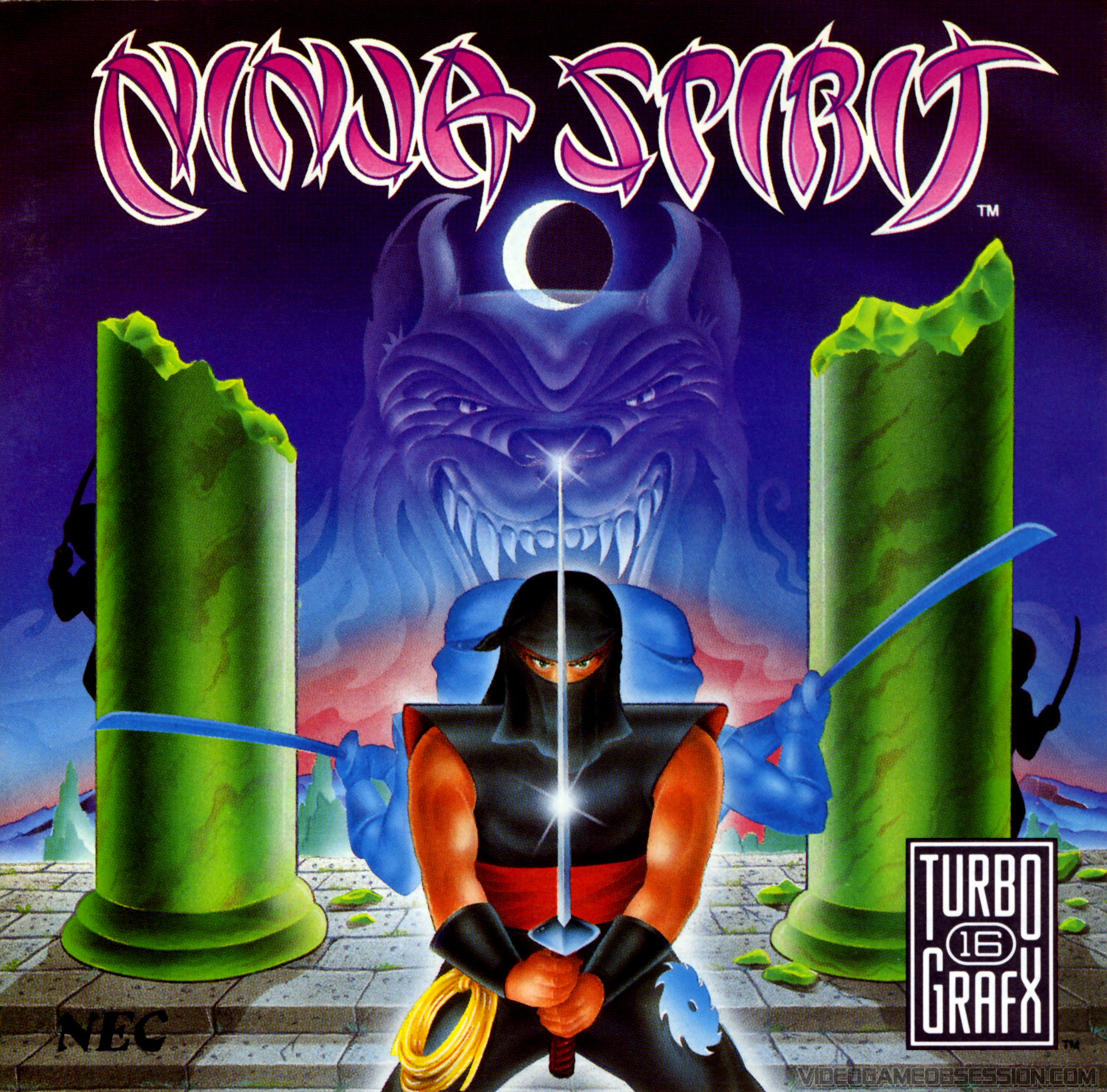
Ninja Spirit/Saigo no Nindou (最後の忍道) - PC Engine/TurboGrafx-16


Ninjas and the late 1980's pair like Grilled Bavette of Bœuf and a 4 year old Merlot. So it's no wonder that a favorite gaming meal of the time was the Ninja Game. One of the best is Ninja Spirit. First released in Arcades, but perhaps best known for the fantastic TurboGrafx-16/PC Engine port.

At first glance, Ninja Spirit looks like a play-alike to the contemporary NES Ninja Gaiden game (released the same year). You're a ninja with a sword, you run left-to-right dispatching anything that moves. And while that's all true, the two games diverge radically from each other. I think an argument can be made that Ninja Spirit is the better game in some ways, particularly game mechanics and mood/setting. So much so that Ninja Gaiden went back and adopted some of the ideas from Ninja Spirit in later games.

Ninja Gaiden (NES)
In play, Ninja Spirit plays more like a much more polished, spiritual sequel to The Legend of Kage (LoK), which hit arcades about three years prior. With floaty jumps, throwing stars, certain enemies leave behind powerups, vertical and horizontal levels for variety and an unapologetic, very Japanese setting -- you could be forgiven for thinking these two games (made by different companies) were related somehow. (Note: LoK did in fact get an actual pseudo-sequel, Demon Sword and then a real sequel on the DS.).


What Ninja Spirit brings to the table is a greatly polished version of the basic LoK game mechanics. Jumping is toned down and under more control, your melee weapon is upgraded to a proper sword, you're given two more weapons, upgrades are more interesting, and the most notable game mechanic, "ghosts" are introduced.

While not the very first game to feature computer controlled ghosts that follow and mimic your player, Mickey Mousecapade did something very similar a year earlier, it's probably the first to both get it right and to use it as an upgrade. Pick up one upgrade and you get an invincible ghost clone that follows your exact movements slightly behind you, but attacks simultaneously. Pick up another upgrade and there are two of you. By carefully planning out where your clone trails  you, you can cover large areas of the screen with a single sword slash. Attacking screen filling bosses then become a matter of positioning your clones to attack from different parts of the screen. It's brilliant and has been copied many times since, notably in Ninja Gaiden II: The Dark Sword of Chaos. It's a single innovation that's left an indelible mark on video games.


The setting and atmosphere of Ninja Spirit is also notable. It's a mystical, ghost and demon filled setting. The color palette is dark and moody, you fight through ruins of old buildings, or cross a plain with voluminous dark ominous clouds slowly crossing the sky. Music crosses into some kind of dark, spooky Japanese electro synth jam and when it comes together it's awesome. Sound effects are designed to mesh well into this framework, the screen clearing power up emits a truly terrifying sound. 

While Ninja Spirit was ported to a number of different platforms, there's something about the TurboGrafx-16/PC Engine port that makes it feel just as valid as the Arcade port. Ports to other systems feel like rush jobs and lose that spookiness that drives the arcade version. Reworked just enough to fit the console, every piece of artwork and music was lovingly recreated from scratch and looks like it could have arrived on the console independently.


Going back to the music. It was one of the things that really drew me to the game originally. The music from the first level reminds me of a downbeat version of the work Yuzo Koshiro did on The Revenge of Shinobi a year later. Not every track is fantastic, but the ones that are good really draw you into the mysterious and dark feeling the game is trying to evoke. Grounded in a modern Japanese take on traditional music, using synths to fill out and drive more traditional sounding instruments, it's still very listenable. The rework for the TurboGrafx-16 is quite good considering the limitations of the sound chip. It's clearly the best home version of the soundtrack. 


This game is also hard, old-school arcade hard. The enemies pour into the screen constantly. In later levels they come in as a flood -- without the refinement of later bullet hell concepts. Finding the right pace to proceed, in order to control the incoming enemies is part of the fairly deep strategy of this game. Bosses are likewise varied and difficult. More importantly, each level requires a slightly different approach to learn with the final level, a fall through a cloud of sword slashing ninjas is maddeningly difficult.

However, there's not a lot of game here. A virtuoso playthrough of the entire game is a shocking sub-20 minutes. Some of the difficulty and length is excusable being an arcade game, they're designed to make you feed in more money every couple minutes. But since the TurboGrafx port was so clearly reworked, why not go the extra mile and really rework it for the home market? I'm afraid this version suffers because of the old focus on "the arcade at home" rather then understanding that home consoles are not arcade games. 

Still it's a good game, and thankfully experiencing it won't take too long. I'd say playing the first 2 or 3 levels will give a player an appreciation for the game before the difficulty just turns your emotions into mush. It's worth it for the atmosphere and music at the very least. There's some really interesting ideas here that would be worth digging back up into a modern indie retro-style game.


Saturday, September 7, 2013

The Revenge of Shinobi/The Super Shinobi (ザ・スーパー・忍) - Genesis/Mega Drive


Like any important, revelatory experience, I remember the first time I played The Revenge of Shinobi. A local friend had purchased a Sega Genesis right around the release and brought the whole kit over to my house. I vaguely remembered Shinobi as a very hard, quarter munching arcade side scroller and so passed on it at first. We played through the pack-in Altered Beast a few times, had some fun repeating the terrible voice acting,  "RISE FROM YOUR GRAVE", and then found ourselves promptly bored. Arcade games just don't play the same when you don't have to worry about feeding quarters into the machine -- a fundamental issue with many Arcade-to-Console ports. I think it's also because I was so used to Altered Beast as an arcade title that seeing it reproduced on a home machine, as good as the port was, wasn't terribly impressive to me. It was just a game.


Then we decided to have a go at The Revenge of Shinobi (RoS). At that time the arcade Shinobi was already considered a little long in the tooth, so it seemed natural to us that it would be essentially the same game, running left to right tossing shuriken at a couple types of bad guys, rescuing hostages, that sort of thing. Perhaps it would have some cleaned up graphics and maybe some more digital voices. If I remember correctly, the sequel to Shinobi, Shadow Dancer had already hit arcades and, while adding a new dog helper mechanic, more or less doubled down on the first game's concept. There was no reason to not assume that RoS wouldn't be more of the same -- the arcade experience at home was Sega's modus operandi after all.


What we got was something oh so much better.

In an odd move, Sega, a company who's mainstay at the time was pretty direct arcade to home ports, completely reimagined what Shinobi could be. This was something more commonly seen on the NES with games like Contra or Ninja Gaiden -- a complete rework of the game from quarter munching quick arcade play style to a deeper and more balanced home console gameplay. RoS was an overhaul of the entire franchise, gone were single hit deaths, and simple left-to-right level designs. In was limited ammo, multiple attack options, elaborate ninja magics, power-ups and more complex level designs.


The other impression that hit us immediately was the sense that this was a game that really couldn't be done on previous systems. If you squinted you could imagine a semi-faithful Shinobi on the NES (which did actually happen) or the Sega Master System (which was even better than the NES version), but Revenge of Shinobi was impossible on previous systems -- with parallax scrolling and beautiful lush backgrounds, huge detailed characters and incredible sounding music and digitized voices -- this was something that the old 8-bit machines simply couldn't do. Nothing announced the arrival of 16-bit to me better than RoS.

It's not to say that developers on the older consoles didn't try to respond. I think the closest response any developer could manage came two years later in the form of Sunsoft's Batman - Return of the Joker for the NES. Characters in that game look and move remarkably similar. Heck, even the basic play mechanics are identical -- walk around jump and shoot relatively static bad guys, destroy boxes for power ups. The influence of RoS on the Sunsoft title is noticeable.


I think the influence was more important in attracting developers who wanted to work on this more powerful system. A slew of games followed RoS that also had a similar character size and playstyle -- almost like a game engine that had been licensed out and reused (ESWAT, Dick Tracy, Decap Attack, Alisia Dragoon, Chakan - The Forever Man come to mind immediately). This visual and gameplay style became almost a Genesis hallmark until Sonic and the mascot games of the 90's replaced it.

The music is astonishing. Written by Yuzo Koshiro, it's an imminently intense synth-jazz-pop with occasional rock elements and is highly listenable outside of the game. I personally believe it's the best soundtrack ever produced on the system. It has a certain sound and sense of style (with a very particular sounding drum-kit) that was never replicated. For a soundtrack on one of the first releases on the system this is astonishing.


Graphics in RoS are, like I mentioned before, something that couldn't be done on an 8-bit system. However, they aren't amazing beyond being a conscious improvement on any 8-bit system's graphics. Sprites move a little stiffer than then contemporary 8-bit characters and the increased size of the characters meant that there was simply less you could see on screen. To compensate RoS and similar games took a decidedly slower pace to the action i.e. Ninja Gaiden's Ryu Hayabusa's run would have introduced new enemies onto RoS' Joe Musashi's playfield too quickly to be reacted to. This is simply one of those cases where graphics do impact gameplay.

There are a few places where the graphics are out and out amazing. The waterfall in stage 2 put the expanded color palette of the Genesis to incredible use - completely outshining other similar levels (the NES Contra's waterfall springs to mind). Most of the bosses are ho-hum, the levels are far more interesting than the boss fights. The most memorable thing about the bosses is that in early versions of the game, bosses were copyright unfriendly rip-offs of well known comic book and movie characters. But then again, the Godzilla boss was huge, reasonably well articulated and filled the screen in a way you wouldn't see in 8-bit gaming.

Curiously, when the individual components of the graphics are synthesized into a play screen, the graphical issues largely go away. The sum is greater than its parts and the graphics hold up strongly against any other game in the Genesis/Mega Drive library.

Gameplay-wise RoS plays great. Your character goes pretty much exactly where you want him to go and enemies and levels have a surprising variety. RoS is the first game I remember having a double-jump mechanic as well - though the timing was sometimes difficult (the Internet says that Dragon Buster from 1984/85 was the first game though). If performed it also unlocked a more powerful shuriken attack. The double-jump is also a required technique for certain levels, not just because of high jumps, but it also transitions the character between foreground and background elements in certain levels. The game normally plays with limited shuriken, so up close you use a melee attack. Depending on your power-up level (there are 2), you might even pull out your sword once in a while.

I'd say the only part of the game I don't enjoy is the final level and boss. Everything form the music to the level layout (an infinite maze) to the difficulty of the final boss simply don't fit the game. It's like a modern glass and steel office building in the middle of a historic downtown area. The music feels like Yuzo phoned it in and the maze just feels like a way to extend the game artificially.

The final boss is likewise out of place. Overly difficult, previous boss fights do nothing to prepare you for the methods you need to use to defeat him. Stacked on top of that is a high pressure timer and it just doesn't work.

Overall, The Revenge of Shinobi is an awesome game. It created a parallel Shinobi universe to the arcade that carried on for quite a while (influencing a fantastic sequel, two Game Gear games and a Saturn game), giving Sega two entirely different takes on the same basic franchise. I have a few small quibbles with it, but when I feel like playing a Genesis game, it's always at the very top of my list -- probably my favorite game on the system. It has a pick-up and play sensibility that's fantastic.