Showing posts with label ponpoko. Show all posts

Monday, January 25, 2016

Elevator Action/ Erebētā Akushon (エレベーターアクション) - SG-1000

Donkey Kong was a major smash hit in video game history and it helped put Nintendo on the international entertainment industry map. It features a proto-Italian plumber dodging barrels and climbing up a single-screen tower of ladders and girders to defeat the giant gorilla Donkey Kong and rescue Pauline.

Donkey Kong
In the years following, a fairly large number of "clones" appeared in arcades and on home systems and computers, trying to capture whatever it was that made Donkey Kong such a money making hit: Hard Hat Mack, Jumpman, Popeye, Ponpoko, BurgerTime and so on. None were exact clones, they all tried various gimmicks and reformulations, and many of them became classics in their own right, but none of them strayed too far from the single screen vertical up-and-down action -- in this Elevator Action isn't too different (except this time with scrolling).

Elevator Action takes a start-at-the-top-and-climb-down-to-win approach. You take on the role of a secret agent, secretly gaining access through a secure building's elevator shaft. As you work your way down the building via elevator, counter agents try to stop you from stealing secrets conveniently located behind clearly marked red doors. At the bottom of the building you hop in a getaway car and move on to the next level where the challenge gets cranked up a notch, repeat until you run out of lives.


The arcade Elevator Action isn't exactly a flashy game, even by 1983's standards, but it's competent. Ports were released for every system under the sun, but the Sega SG-1000 version interests me the most because of how spare the system resources were at the time. (Note: there was an Atari 2600 port under development, but it was never finished and the leaked game is not quite complete enough to be called a complete game).

Not even as powerful as a ColecoVision (and almost compatible with it), the SG-1000 was Sega's first entry into the home console market and came out a year after Coleco released their console and the same year Nintendo released their gaming colossus, the Famicom -- the SG-1000 never really stood a chance in the market. However, Sega kept trying, releasing a home computer version (that may have informed the legendary MSX standard), an SG-1000 II, then the Mark III, then the Master System and finally achieving global success with the Mega Drive/Genesis. Every one of those systems traces lineage back to the SG-1000.

So it's interesting to see what developers did, faced with the challenge of porting a complex arcade game to hardware so limited it couldn't even display two colors on a given sprite and could only show 16 colors at a time.

One of the things that set Elevator Action apart from other Donkey Kong clones was that Agent 17 ("Otto") is a surprisingly expressive character to control. He has lots of game verbs for a 1983 video game avatar. He can shoot his pistol, jump kick, control elevators, ride on top of them, shoot out lamps (rendering the game dark for a time), ride escalators, jump across elevator shafts, duck under enemy fire, enter red doors and probably a couple more things I can't remember. I'm hard pressed to think of another video game character that can do so many things until Super Mario Bros. redefined how characters should control 2 years later.

Elevator Action is also a violent game. You literally clear a skyscraper by going floor to floor and shooting everybody you see, regardless of any hostile behavior on their part. If you aren't shooting them in the face, you're kneeling and shooting them in the legs or crotch, dropping light fixtures on them, jump-kicking them or in rare circumstances crushing them with the elevators themselves -- turning conveyance into deadly weapon. Philosophically it may be that you are actually the bad guy in this game.

Elevator Action on the SG-1000
Distillation is the process of heating a liquid composed of several components in order to separate them. It's used in the production of petroleum products from crude oil and the production of hard liquor. And this is what the SG-1000 port of Elevator Action is, the distilled hard liquor of the original. It keeps just enough of the game there that you know you are playing the same game, while tossing everything else that's wasn't necessary. It's a remarkable piece of design editing. The graphics are just this side of representational, the signature theme song is intact, your jump arc is correct, even the height of your duck position is correct -- something that not every port got correct.

When compared to other ports on other limited systems, like the ZX Spectrum, it really shines. The Speccy port is a complete redesign of the game and it suffers from this, elevators move too fast, the character's signature duck (allowing enemy bullets to zip right over the classic hair style) is turned into a dive, the bullets move wrong, escalators are weird two part affair and so on. Everything important is here in the SG-1000 version.


There's only a couple places where maybe a little too much was edited out. The first is that your enemies are far more aggressive than the original (or other home ports), often firing the moment you can be hit. This amps up the difficulty so it feels more like the second or third level of the original. There's also a weird bug that sometimes prevents Otto from getting onto available elevators, sometimes putting you into poor tactical positions.


Still, these are minor issues with an otherwise great port of the arcade original. Despite being (or maybe because) such a violent game, I find it strangely soothing to play after a frustrating day at work. You jump in, shoot guys in the face or crush them under elevators, steal secrets and make your getaway. It seems really simple on the surface, but there's a strange depth to the gameplay that keeps it fresher and more interesting than you would think. The SG-1000 port distills this down to perfection and I find myself returning to this version of the game more than any other port -- even later easier versions with more gameplay options.
Tuesday, August 6, 2013

Ponpoko/너구리 (Neoguri)/Ponpoko (ポンポコ) - Arcade


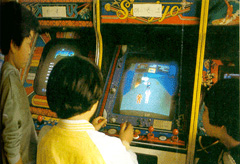
1982 in South Korea was a strange time. The country was on the slow climb out of a long dictatorship into modern Democracy, massive industrialization and conglomerates dominated the economy and intense trade and cultural protectionism dictated the import/export of goods. Starting around the end of World War II, South Korea banned "cultural" imports from Japan -- this included video games. It wasn't until 1998 that the import restrictions were relaxed some. On top of this, a strict morality code dictated the kinds of cultural items that could legally find their way into the economy -- censors frowned on excessive violence and adult themes. To put this into perspective, one of the most highly promoted and popular shows on Korean TV during the 1980s was mullet wearing, gun eschewing, smart guy MacGyver.

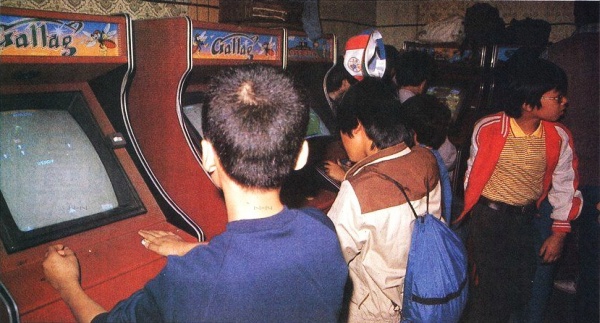
This doesn't mean that video games were unknown in South Korea. On the contrary, building up the electronics industry in South Korea was a major strategic focus of the government and videogames are a major electronics business. A loophole in the law, conglomerates could license foreign technologies and build/market them in South Korea, allowed versions of many consoles to find their way into the Korean market. Still, these restrictions frustrated gamers and a huge illegal underground market flourished.


Why all this about South Korea? Without the free flow of games from the booming Japanese games market, Korean gamers had to make do with what they could get. This skewed the history of that market in strange directions. Almost entirely unknown in the west, Ponpoko, known as 너구리 (Neoguri) in Korea, is widely regarded there as a classic game and had a welcome spot in most arcades, legal or not. As far as I can tell, it may have been more popular in South Korea than in its native Japan.

It's in South Korea that the game still lives on, a youtube search for "Ponpoko" yields a few results. A search for "너구리" finds speed runs, remakes, reviews. In fact Ponpoko, as 너구리 (Neoguri) has been remade in South Korea again and again and again.


In the interest of even more context, 1982 was an interesting time in Arcade games. Just two years prior, in 1980, the first credited platform game ever was released -- Space Panic (though there's some dispute if Sega/Gremlin's 1978 Frogs owns this title). A year later, in 1981, Donkey Kong hit the market. In 1982, the market was flooded with platformers. Most of them were primitive, but a few stand out as all time classics: Donkey Kong Jr., Joust, Q*bert plus less regarded, but still popular: Popeye, and Jungle Hunt. It's no wonder that with massive heavy weights like that in the same arcade, poor Ponpoko just never really caught on in most countries. It's also interesting that a near clone of Ponpoko, heavyweight Atari's Kangaroo was also a 1982 arcade release and saw much wider release in the West.

As an early platformer, the influence of the 1981 platform games on Ponpoko is clear. In Ponpoko, you guide a little Tanuki around a single playfield made of platforms. Similar to both Space Panic and Donkey Kong, you move between platform levels via ladders. To advance you collect a number of food items. The food changes each level, likely inspired by Pac-Man from two years before. Bonuses come in the form of a Donkey Kong-like time bonus for fast completion and extra points from bonus jars spread throughout the level.

Hazards come in the form of enemies who crisscross their platform, tacks spread throughout the level, enemies hidden in the odd bonus jar and an important innovation, fall damage from falling off a platform.

The tacks, platform placement and an interesting two-level jump mechanic (the jump button does a small jump, forward + jump provides a flying leap) introduces one of the first appearance of a complex jump puzzle in gaming -- or at least is a big improvement over what was seen in Donkey Kong.

Because the enemies simply mill about and don't follow you, and the level layout stays the same from game to game, it plays like a reflex memorization puzzle. With the added incentive that the biggest scores come from beating the bonus timer, you want to play over and over to find more optimal paths through the level and learn the patterns. Interestingly, "pattern" is what this game calls it's progressively more difficult levels. Very unusual for 1982, there's tons of levels -- 20 at my count.

Your tanuki has no offensive weapons at all. The game is purely an agility exercise and reminded me in many ways of 1984's Impossible Mission. The combination of the bonus timer, easy memorization, jump puzzles and level count in addition to fun graphics and little reward tunes make Ponpoko downright addictive.

So what are the problems with Ponpoko? For one, it's working off of, by 1982 standards, outdated Pac-Man hardware. Enemies may have 2 frames of animation, and your character has maybe 5. The character designs and music are also not very memorable. To most players, the enemies and the main character are virtually unrecognizable.

Control and hit detection are also a little fussy. The tanuki jumps with a difficult to gauge animation making even simple obstacles like tacks into life threatening weapons of death. Worse yet, guessing which jumps between platforms you can make and which are just a hair too far is impossible without pure trial and error.

I think that if Ponpoko had been released in 1981, we'd remember it today as an all-time global classic, have disco songs about it, cartoons, and people would recall fondly going on a date at the local roller rink and stopping to play a few rounds. But in the fast moving and ultra-competitive arcade market of the early 1980's the only place it seems to have really caught on is in illegal arcades in a South Korea winding it's way out of occupation, war and dictatorships.


Further reading:
Mamedb's game page
Hardcore Gaming 101's incredible History of Korean Gaming
Hardcore Gaming 101's discussion board
A modern flash remake
An emulab discussion about permissible games in Korean Arcades
MAME Puckman driver source code
Arcade Archives review of Ponpoko