Sunday, March 16, 2014

Kid Icarus/Hikari Shinwa: Parutena no Kagami (光神話 パルテナの鏡) (Myth of Light: The Mirror of Palutena) - Famicom/NES


Many years ago, when Nintendo was still building out franchises, and before backgrounds became common things in NES games, they produced a reusable game engine. In the mid-80s (especially mid-80s Japan which still struggles with modern software practices to this day) this was pretty mind-blowing. This engine was used in two games, one of the two games, Metroid, has become the stuff of legends even spawning it's own game genre name. The other, Kid Icarus is no less loved, but has always sat in the shadows of it's big brother.

Growing up, I was aware of Kid Icarus (KI), but fighting space aliens was so much more relevant to young me than Greek legends. I remember playing it one time on a game kiosk and feeling very non-plussed about it. I was surprised to learn, years alter, that the same designer and engine were used in both games. When sitting down to review it, I really wanted to analyze why that was, and why I couldn't find the love for this game that I know many others have and why did I love Metroid but hate KI? It turns out these were the wrong questions. KI is an amazing game, and my feelings were based on just the purely superficial first impressions I had as a kid.
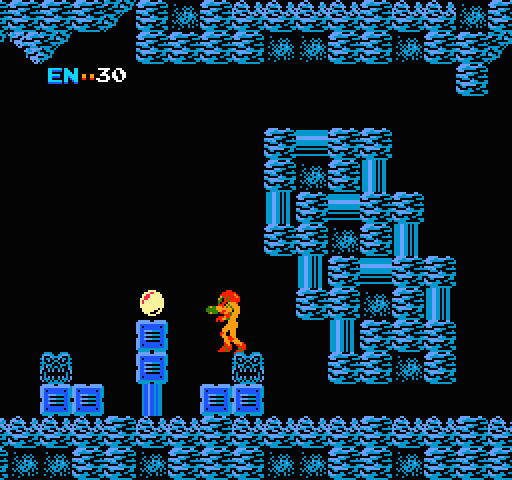
However, the first impressions of the game are hard to get past. Like Metroid, you start severely underpowered. But I feel like Metroid starts the player up the learning curve more gently. Metroid uses all kinds of small hints to train the player about the world. You try to run right, you can't. So it forces you to run left where you find your first power-up. You start with a couple weak enemies in unthreatening placements so you can practice aiming and learning that you can fire up as well as horizontal. All these things clue you in to how the game world, for the rest of the game, is going to work.
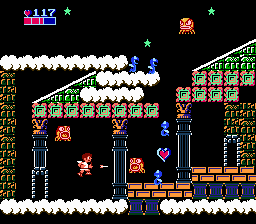


Kid Icarus, doesn't really do any of these things. You start weak, and enemies are thrown at you from the beginning. You collect hearts, but they don't restore your life, and you climb climb climb perpetually up. There are doors, but the first few you find don't really help you. The difficulty is relentless. My first couple plays, I died so early and so often I thought that the game was merely a metaphoric vertical climb up Mount Olympus till the end of the game (it's not just vertical). If you make it further along, you eventually come across stores and everything is terribly expensive and items don't really seem to amp you up in a meaningful way and don't really make much sense.

You feel weak, under-powered and overwhelmed.

It was at this point that young me turned the game off and went off to play Kid Niki Radical Ninja. But modern me wanted to figure this game out. It turns out I should have kept playing. Pretty quickly I made it far enough to hit a horizontal level. My shot range increased, I started to power up. Like Metroid, the enemies in KI don't necessarily get harder as the game progresses, there's just more of them. By the late game, you're so powerful that what used to terrify you, you can handle with confidence. The feeling of empowerment is pretty cool.

What really surprised me about KI was not the vertical and horizontal levels, but the Labyrinths. I feel like this is where the game really comes together. You go back to being under-powered in the Labyrinths, but the combination of the exploration really makes these levels feel like a mini Zelda-like action RPG inside of the rest of the game -- or at least like Zelda's dungeons. The feel far more sophisticated than an early NES game has any right to feel.

Was this...

The inspiration for the Labyrinths?

Even more innovative, while wandering the dungeons, you can smash open statues to recruit helpers for the upcoming boss battle. They're not as decisive as I would have hoped, but the idea of playing a 1986 NES game with AI bot companions is pretty awesome, and they make you feel really ready for the boss battles, despite being powered down for the Labyrinth.

Finally, if you make it through the final and most challenging massive Labyrinth, you're rewarded with a great horizontal shmup level. It was a huge surprise to me and put a broad smile on my face. And it's this huge variety of KI that I really found remarkable. What I first thought would have just been a vertical climbing slog with an overamped difficulty level turned out to be a game full of almost Contra-like variety and play styles.

This game is pretty long for the time period and considering it's not an RPG. A quick run through by somebody who knows what they're doing takes about an hour and a half. Along the way there's some decent music -- nothing earth shattering, but welcome cheesy adventure accompaniment. There are plenty of fans though, and it hasn't stopped anybody from making cover version of some of the songs.


Graphics are actually pretty good for the time -- they don't hold up terribly well today, but characters have a definite cartoony feel and there's lots of effort put into giving them personality. What's lacking are background graphics, you play against a solid background for the vast majority of the game. It's fine in the way that this is fine with Metroid, but it's definite reminder of the age of the game.


Controls are pretty tight. Pit, your character, goes pretty much exactly where you ask him to. It's typical Nintendo polished play control. I have a few minor quibbles with platform hit detection, and jumping while aiming up, but on a game of this vintage it's excellent.


Despite being a popular, polished game, Kid Icarus has a more difficult legacy than Metroid. It got a Game Boy sequel, which improved on the formula in many ways. And Pit appeared in numerous Nintendo promotions. There's been a port of the original to the GBA, and a 3D Classics port (with some fixes for the controls), But that's about it. It even took an independent studio, risking the wrath of Nintendo's legal team to release a 16-bit style sequel.

Nintendo left this franchise on the shelf, basically to rot, generation after console generation until finally releasing a much praised 3DS game. It sold pretty well, but Nintendo, bizarrely has decided to back burner the franchise again. Considering the opportunity to add essentially all of a modified Greek pantheon to their IP stable, the decisions to not breath constant life into Pit is head scratching.

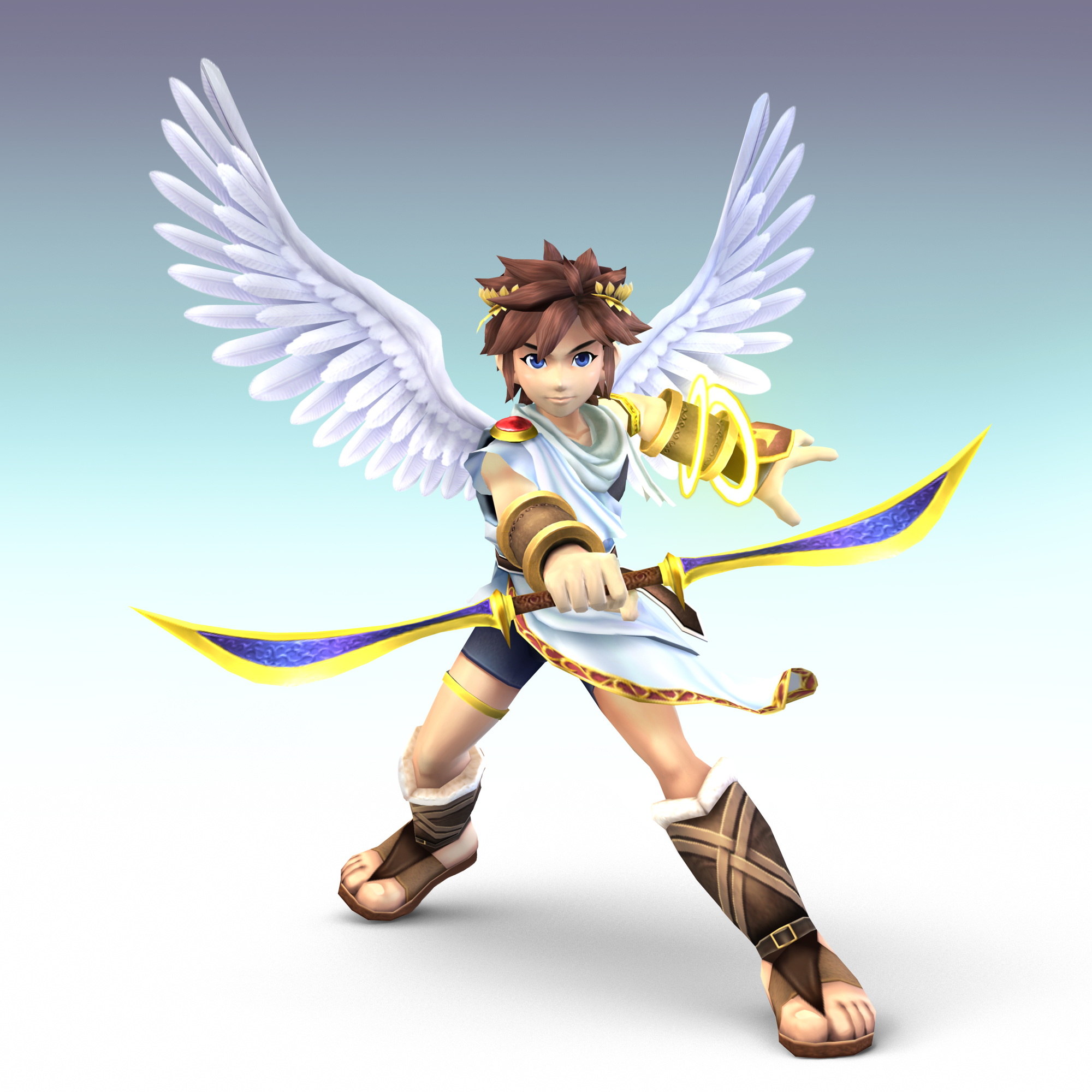
Given all that, I'm glad my initial impressions were wrong, I'm now a Kid Icarus fan.


Friday, March 14, 2014

Rock n' Roll Racing - Super Famicom/SNES


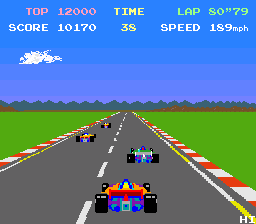
Let's be honest, until at least Ridge Racer on the PlayStation, 3d-style racing games were mostly derivative, definitely haven't aged well and most honestly weren't very good. It really took the jump to fully modeled polygonal tracks and cars to break the "driving towards the apex of a triangle" sameness that many early racing games suffered from.

This view of racing was largely unchanged for years

Sega, of course pushed this view of racing to impossible extremes with their Super Scalar sprite scaling technology and tried to fake a true 3d experience for years -- eventually even replacing the road triangle with dozens of quickly scaling sprites. Even Taito's fabulous Night Striker pushed the concept about as far as it could go.

It was obvious, even in the mid-80s that this approach was an evolutionary dead-end for racing games, but technology simply couldn't offer a more realistic experience. One alternative, the top-down racer like Atari's 1986 Super Sprint.

An alternate view of the world.
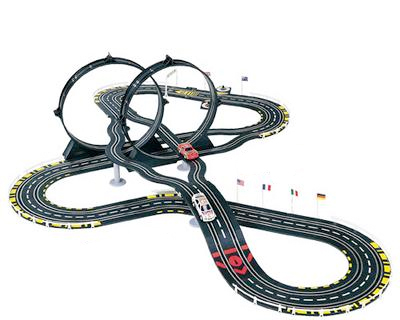
This kind of view, rather than trying to take you into the experience of racing an actual car, more closely resembled playing with slot cars. Which, if you were a kid in the mid-80s, was awesome.

The technical barrier to making these kinds of games fun and good looking is much lower -- and I think that means that the developers had more time to tweak the game mechanics and add things like power ups and racing physics to the mix. To help give the games a little graphical boost, a common variant was the isometric racer. Unlike isometric platformers or puzzle games, this view actually works, and it works really well.

One of the earliest of these was Racing Destruction Set (RDS) on the Commodore 64. Which, while a fine game for 1985, didn't really create an immediate impact. However, it set the template for how an isometric racer should work. By zooming in on the action, it limits the view of the course. Since you are no longer an omniscient god with a view of the entire track, some of the tension of a first-person racer remains -- you don't see where all your opponents are all the time. It also introduced a combat system that made the game more than just running flat out till the end of the race.


In the arcades this was ignored and we ended up with 1989s Ivan "Ironman" Stewart's Super Off-Road. While fun, it was clear that it lacked the deeper strategy of an isometric combat racer, and it moved the viewpoint back out to a single screen overview of the action.

However, in 1988, these lessons weren't lost and we got one of the most popular isometric racers of all time, Rare's R.C. Pro-Am.


R.C. Pro-Am (RPA), proved that RDS's template for how an isometric racer should work was the right one.

Fast forward a few years to 1991 and it's time to make a racer for the SNES. At this point, despite being one of the most powerful home systems at the time, the choice for making a racer were pretty much driving into a triangle or yet another F-Zero/Super Mario Kart clone -- and there are tons of each. Looking back a few years, developers Silicon & Synapse realized that a third, mostly ignored option existed.

Reaching back more than half a decade, they realized that a modern (for the time) isometric racer might fit the bill. They decided to combine some of the slick breeziness of RPA with the deeper play mechanics of RDS and ended up producing RPM Racing. RPM is a good game, but it just doesn't really have a voice. Despite being one of the only racers of it's type, it doesn't stand out in the crowd.


Still, they were on to something, the formula was just off a bit. In a weird example of where the marketing department actually helped product development, the idea of using licensed rock music in a RPM sequel was hatched. Add in a bit of 90's "'tude", speed it up a bit and we get the excellent Rock n' Roll Racing (RnR).

One of the first things you notice about the game is the amazing renditions of popular rock songs. The work that went into bending to the SNES sound chip to produce such excellent tunes remains one of the high-points of SNES sound design. Hammond B3 organs, rock drum kit, bass and wailing guitar solos are all intact. It really wasn't until optical disks became the norm for videogames that a better sounding rendition of these songs could be heard in a game.

It's also a virtuoso example of how much better games sounded on the SNES vs. the Genesis. Despite a noble effort, the Genesis port of this game just doesn't have the same feel because the music doesn't push the pace along in the same way. To be honest, I quite often just kept playing because I wanted to know which one of the half-dozen tracks would be next.


And I think it's this amped up music that forced the designers to push the game's pace along. The almost lethargic RPM Racing turns into a frenetic, pedal to the metal rush in Rock n' Roll Racing.

Game mechanics-wise, there's really nothing surprising about RnR. You drive in a race with 3 competitors, firing weapons and dropping mines. Finish in the top 3 and you collect purse money you can put towards upgrades for your car or even buy a new car (better cars are unlocked as the levels progress). Tracks get harder as the game moves on and your opponents are upgrading just like you. Knowing when to buy an upgrade and when to save for a more expensive purchase it part of a fairly deep strategy system.

Combat is pretty straight forward, you can fire projectiles, drop mines or boost your speed temporarily. The specifics of the weapons vary a bit depending on which car you are upgrading. You can also upgrade your engine, traction, armor etc.

One of the really great things about RnR is the smooth and continuous progression of difficulty through level design and the constant upgrading of your opponents. Controls are spot on. Power slide around corners, or as you upgrade your grip hit a racing line, it's almost effortless. Weapon usage is simple and intuitive.

About the only negative I can say about the racing experience, and the only point where I hit some frustration was lining my vehicle up in the isometric perspective to make a jump, only to land off the track and lose a few seconds -- or the race. This happened numerous times and I never seemed to get any better at it. Most of the time it's not a problem, but a few tracks are designed to make this a challenge.

Graphics are pretty good. They may not be the best the SNES ever saw, but they're a clear upgrade over RPM and have a sense of style and direction. Vehicles are cool and muscular monster trucks and aerodynamic tanks, tracks have spikes or Giger-esque biomechanic stylings. The art direction is solid and nothing detracts from the game.

Sound effects are a mixed bag, but to be honest, you'll be so busy racing to the music that it doesn't really matter much. This is an approach I think that was later copied by games such as Wipeout and Ridge Racer.

RnR is much loved but it's had troubled offspring. What seemed ripe for formulaic sequels simply didn't get any. Rock and Roll Racing 2 for the Playstation was kind of an unremarkable dud that like many early 3d games hasn't aged well at all. However, a spiritual copy, Motor Rock, is a love letter to the original and I highly encourage players looking for a modern take on RnR to get it if you can hunt it down. It nails everything about what made RnR special.

Sunday, February 9, 2014

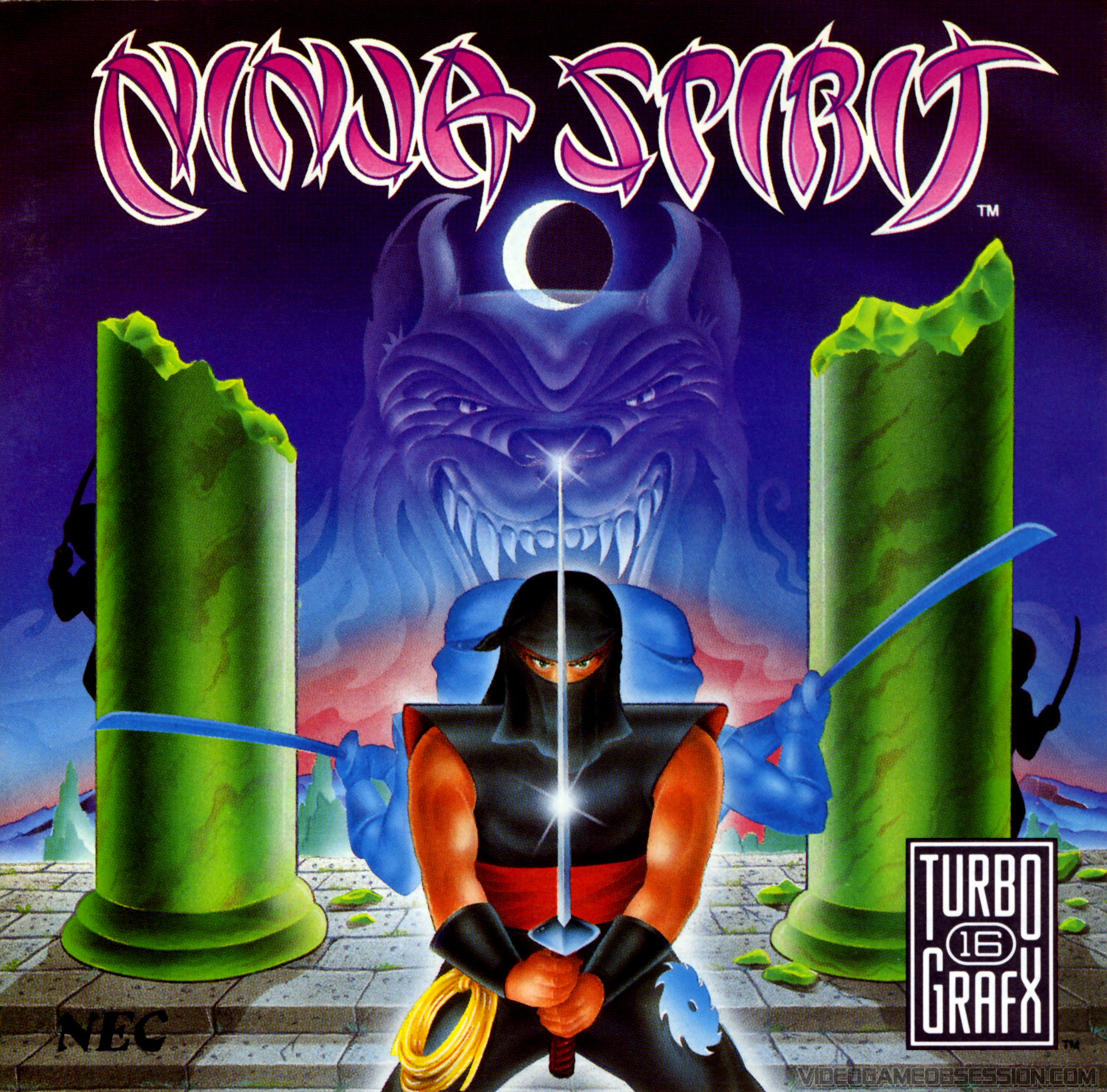
Ninja Spirit/Saigo no Nindou (最後の忍道) - PC Engine/TurboGrafx-16


Ninjas and the late 1980's pair like Grilled Bavette of Bœuf and a 4 year old Merlot. So it's no wonder that a favorite gaming meal of the time was the Ninja Game. One of the best is Ninja Spirit. First released in Arcades, but perhaps best known for the fantastic TurboGrafx-16/PC Engine port.


At first glance, Ninja Spirit looks like a play-alike to the contemporary NES Ninja Gaiden game (released the same year). You're a ninja with a sword, you run left-to-right dispatching anything that moves. And while that's all true, the two games diverge radically from each other. I think an argument can be made that Ninja Spirit is the better game in some ways, particularly game mechanics and mood/setting. So much so that Ninja Gaiden went back and adopted some of the ideas from Ninja Spirit in later games.

Ninja Gaiden (NES)
In play, Ninja Spirit plays more like a much more polished, spiritual sequel to The Legend of Kage (LoK), which hit arcades about three years prior. With floaty jumps, throwing stars, certain enemies leave behind powerups, vertical and horizontal levels for variety and an unapologetic, very Japanese setting -- you could be forgiven for thinking these two games (made by different companies) were related somehow. (Note: LoK did in fact get an actual pseudo-sequel, Demon Sword and then a real sequel on the DS.).


What Ninja Spirit brings to the table is a greatly polished version of the basic LoK game mechanics. Jumping is toned down and under more control, your melee weapon is upgraded to a proper sword, you're given two more weapons, upgrades are more interesting, and the most notable game mechanic, "ghosts" are introduced.

While not the very first game to feature computer controlled ghosts that follow and mimic your player, Mickey Mousecapade did something very similar a year earlier, it's probably the first to both get it right and to use it as an upgrade. Pick up one upgrade and you get an invincible ghost clone that follows your exact movements slightly behind you, but attacks simultaneously. Pick up another upgrade and there are two of you. By carefully planning out where your clone trails  you, you can cover large areas of the screen with a single sword slash. Attacking screen filling bosses then become a matter of positioning your clones to attack from different parts of the screen. It's brilliant and has been copied many times since, notably in Ninja Gaiden II: The Dark Sword of Chaos. It's a single innovation that's left an indelible mark on video games.


The setting and atmosphere of Ninja Spirit is also notable. It's a mystical, ghost and demon filled setting. The color palette is dark and moody, you fight through ruins of old buildings, or cross a plain with voluminous dark ominous clouds slowly crossing the sky. Music crosses into some kind of dark, spooky Japanese electro synth jam and when it comes together it's awesome. Sound effects are designed to mesh well into this framework, the screen clearing power up emits a truly terrifying sound. 

While Ninja Spirit was ported to a number of different platforms, there's something about the TurboGrafx-16/PC Engine port that makes it feel just as valid as the Arcade port. Ports to other systems feel like rush jobs and lose that spookiness that drives the arcade version. Reworked just enough to fit the console, every piece of artwork and music was lovingly recreated from scratch and looks like it could have arrived on the console independently.


Going back to the music. It was one of the things that really drew me to the game originally. The music from the first level reminds me of a downbeat version of the work Yuzo Koshiro did on The Revenge of Shinobi a year later. Not every track is fantastic, but the ones that are good really draw you into the mysterious and dark feeling the game is trying to evoke. Grounded in a modern Japanese take on traditional music, using synths to fill out and drive more traditional sounding instruments, it's still very listenable. The rework for the TurboGrafx-16 is quite good considering the limitations of the sound chip. It's clearly the best home version of the soundtrack. 


This game is also hard, old-school arcade hard. The enemies pour into the screen constantly. In later levels they come in as a flood -- without the refinement of later bullet hell concepts. Finding the right pace to proceed, in order to control the incoming enemies is part of the fairly deep strategy of this game. Bosses are likewise varied and difficult. More importantly, each level requires a slightly different approach to learn with the final level, a fall through a cloud of sword slashing ninjas is maddeningly difficult.

However, there's not a lot of game here. A virtuoso playthrough of the entire game is a shocking sub-20 minutes. Some of the difficulty and length is excusable being an arcade game, they're designed to make you feed in more money every couple minutes. But since the TurboGrafx port was so clearly reworked, why not go the extra mile and really rework it for the home market? I'm afraid this version suffers because of the old focus on "the arcade at home" rather then understanding that home consoles are not arcade games. 

Still it's a good game, and thankfully experiencing it won't take too long. I'd say playing the first 2 or 3 levels will give a player an appreciation for the game before the difficulty just turns your emotions into mush. It's worth it for the atmosphere and music at the very least. There's some really interesting ideas here that would be worth digging back up into a modern indie retro-style game.


Saturday, January 4, 2014

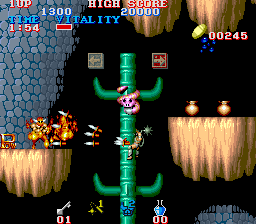
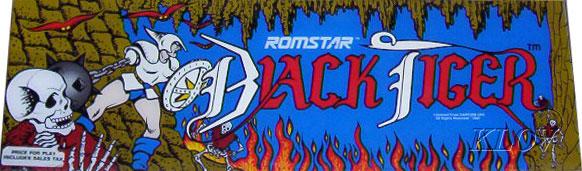
Black Tiger/Black Dragon (ブラックドラゴン) - Arcade


The later part of the '80s was an interesting time in video game sequels. Still developing as an entertainment medium and art form, rules were literally being written with every new game release. While cinema was stuck with the idea of sequels being more of the same but with more, video games hadn't really arrived at that conclusion yet. Nothing represents this better than the sequels in name only phenomenon of 1987.

In 1985 the world received Super Mario Brothers, The Legend of Zelda and in 1986, Castlevania. In 1987 these hits were followed with the very different Super Mario Brothers 2, Zelda II: The Adventure of Link, and Castlevania II: Simon's Quest (yes, Super Mario Brothers 2 was a different game in Japan, but I think the concept is sound). There are other examples of this, but it seems that the zeitgeist among Japanese videogame developers in 1987 was that sequels should be larger in scope, feature different gameplay mechanics, emphasize exploration and in some cases the prevailing trend in Japanese game design, the insertion of RPG elements of various degrees.

1985 also saw the release of Capcom's Ghosts 'n Goblins. This is the part where you ask what my point is since the official Ghosts 'n Goblins sequel, Ghouls'n Ghosts, came out in 1988 and definitely falls into the cinema style "more of the same but with more." However, if you squint a little, the 1987 Black Tiger/Black Dragon arcade release falls perfectly into the established oddball sequel pattern. I think it was probably intended as a sequel, but late in the development was branched off and disowned.


Compared to Ghosts 'n Goblins, the scope is expanded, RPG style elements have been introduced, the focus is more on exploration than just fighting, gameplay mechanics are different and the setting is a very similar horror theme - enemies even climb out of the ground. Black Tiger is often called a spiritual sequel to Ghosts 'n Goblins, but I think of it more as a direct sequel in the context of the times. The sad thing is that history has largely forgotten about this almost second act to Ghosts 'n Goblins; and Capcom acts like it never existed. It's too bad because this is an excellent arcade platformer.

One of the remarkable things about Black Tiger is how well it's aged. I remember walking into my local arcade, sometime in the mid-90s, and seeing it side-by-side with other games from the period and not thinking it looked dated or old in any way. In fact it looks and sounds as good as any 16-bit game from the period, except it was an 8-bit Z80 powered game from almost a decade earlier. Today it still holds up well to modern retro-style platformers in graphics, sound and design. That it hasn't been a template for more modern retro platformers is probably due to its semi-forgotton status.

Gameplay is arcade simple with tight and solid controls. You can walk up and have a good time with your first quarter. You run, jump, climb around and explore the level while beating a fairly wide variety of enemies with your mace and an infinite supply of throwing knives. Jumping feels a hair old fashioned with no in-air control (though you can change the direction you attack while jumping), but you get used to it fairly quickly. Traps spring on you from walls, boulders fall out of the sky, locked chests may contain treasure or booby traps. Each level contains a try-once dungeon you can enter to get more loot -- finish the dungeon or die and the entrance is sealed.

RPG elements come in the form of armor and mace upgrades, which you buy in-game from old men you rescue with the rather limited money you collect. Money is surprisingly scarce and items are often dauntingly expensive. Deciding to save your cash or buy now is a small bit resource management that becomes more important in later levels.

Levels are cleanly designed playgrounds, with loads of variety and large areas, encouraging lots of exploration. You don't ever get lost, but you do worry that you've missed a stash of gold somewhere or an enemy that provides a high payout upon defeat.

The Level 1 Map
Black Tiger's music is also somewhat notable. Each level features variations on the same core catchy theme song. A song that will slowly worm its way into your ears and you'll find yourself humming it long afterwords. Intro music and boss battles are different just to mix things up. But it's otherwise moody and well done.


Black Tiger is a rare thing, it's an arcade platformer in the style of a console platformer. They aren't unheard of, but they aren't exactly common either. Most of the really notable games of this sub-genre were made by Capcom: Willow, Midnight Wanderers: Quest for the Chariot (part of the Three Wonders collection), Bionic Commando and a small handful of others. Despite being wildly popular in the home market, for whatever reason, probably economic, but also the difficulty with making this type of game work in coin-ops, this genre really didn't last past the early 90s in Arcades. Yet, with few exceptions, Black Tiger feels like a home console platformer game.

Another notable thing about this game is that it's rather long. Most arcade games try to keep the player entertained for a few minutes in exchange for their quarter. Players willing to pump more into the machine get a few more minutes. But the entire experience is usually over in under a half-hour. As I noted in my review of Life-Force for the NES, the entire original arcade Salamander game lasts only about 15 minutes. Ghosts 'n Goblins runs for about 20 minutes and the "official" sequel, Ghouls'n Ghosts runs about 30 minutes or so. Black Tiger takes a virtuoso player almost a full hour.

In many ways, it seems like Black Tiger would have been an obvious direct-to-home console release. It did make an appearance on home computers of the time -- to varying levels of fidelity. But until the modern retrogaming scene, virtual console and all that, it never found its way to home consoles. It may have been a bit much of a game for the 8-bit consoles of the time, and felt to be too old once the SNES and Genesis reached critical mass a couple years later. It could have been poor reception of the home computer ports that waived Capcom off from porting it.


So where does that leave Black Tiger's legacy? Though it's a great game, it's also a weird step-child, not even acknowledged as part of the venerable Ghosts 'n Goblins family. Some say that the 1990 release "Magic Sword" is the follow up. But I don't agree with this. Magic Sword clearly paying homage to D&D (probably setting up Capcom for the eventual Dungeons & Dragons arcade games of the mid-90s) while Black Tiger feels more GnG. Ernest Cline's "Ready Player One" gives it proper respect with characters in the book fighting through a 3D remake of the Black Tiger world. Cline even goes so far as to call Black Tiger his favorite arcade game. With some of the arcade cheapness cleaned up and a few minor control tweaks, Black Tiger could have been a premier home console platformer. It coulda been a contender.


Thursday, December 19, 2013

The Ninja Warriors (Again) (ザ・ニンジャウォーリアーズアゲイン) - Super Famicom/SNES


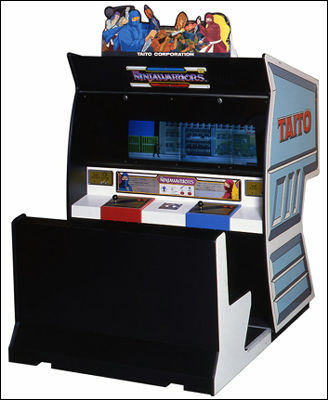
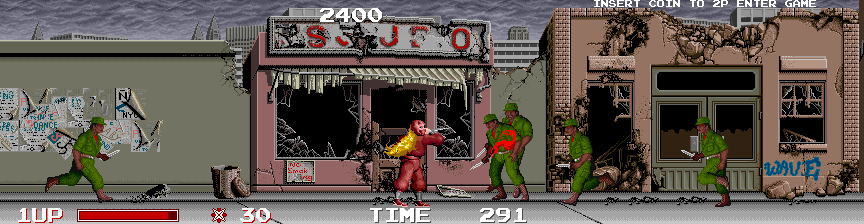
I remember walking into an Arcade and seeing this massive 3-screen spectacle full of jumping ninjas and army guys. It was probably the single most impressive game in the place at first glance. The Ninja Warriors was an immediate draw and drained two-quarters right out of my pocket. The animation was fluid and smooth, battle damage was brilliantly indicated as pieces of your character's clothes ripped off, the music was a pumping synth-rock and the entire experience was top-notch at first glance. The problem was that there really wasn't much of a game there once you dug in beyond the initial surface. You walked to the right and used your two or three moves against an endless army of nameless mooks. After about 15 minutes I was bored to tears.


Taito used a similar 3-screen setup for its Darius games. In fact, instead of just putting three screens side-by-side and dealing with the bezels, the first and third screens sat down in the cabinet and pointed up at mirrors that surrounded the middle, forward facing, monitor. The gave a nearly seamless extra widescreen that was impossible with any other technology of the time and like movie magic that's all smoke and mirrors was an unmistakable attention grabbing special effect in the arcade that's still not matched in the home experience today.


Still this game proved popular enough to receive quite a few home ports (minus two of the screens) to most of the major systems of the time. The TurboGrafx-16/PCEngine and the SegaCD/MegaCD ports were probably the best. However, the basic gameplay remained sadly unchanged and the game more or less fell out of memory.


So when Taito decide to release Ninja Warriors for the SNES/Super Famicom I think it was assumed it would be yet another direct port. Instead Taito decided to give the job to Natsume and gave them more or less free reign to properly adapt the game to the home market.

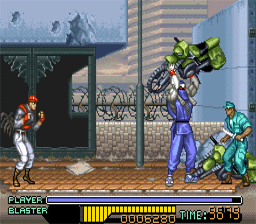
Natsume kept the signature female robot ninja, the army of nameless mooks, the great graphics and animation and the title and then pretty much tossed the rest. What came out of the complete redesign processes is probably one of the most polished games of the 16-bit generation.


The arcade also had a second player male ninja, which in this version was amped up into a huge mechanized nunchuck whipping monstrosity and then added a third robot with bladed forearms to literally tear through the enemy. Taking this group of robot killers, the game then blessed them each with an surprisingly large move list. So large that I'm still finding new moves and ways to use the characters years later. The character play kind of like a cross between a full-on fighting game like Street Fighter II and Final Fight but is unique enough to feel completely like its own game.


Gameplay here is king.

There's other differences as well. This is one of those rare beat-em-ups that's not set in a simulated 3d space (often called a belt-scroll). You'd think that the lack of the extra dimension would limit the gameplay options, but somehow it still works and I think keeps the game moving at a faster pace. Instead of walking around groups of enemies for better position, or exploiting bugs in the hit boxes, you have to jump around or throw individual enemies to group them.

There's also loads of tossable items, motorbikes, computer consoles, crates full of lifebar energy and more. The environments are also full of destructible background bits, energy conduits, vats and other sundry -- toss an enemy through the air and his lifeless corpse takes out some valuable equipment and six of his closest friends. It's unbelievably fun.


There's also loads of enemies that all use different attack strategies. Even the palette swap enemies act differently. Some hang back, then come in for a low attack, others run in direct, others are tall armored robots. There's even entire groups of martial arts experts and long range snipers. Bosses are similarly varied and creative. From a light bending predator like to a cane wielding bond villain who can call on an orbiting ion cannon. On top of this, the levels toss all manner of cinematic special effects at you. In a few places you have to dodge mortars, helicopters firing a side-mounted vulcan and more. This game keeps tossing more and more at you and never gets boring.


Sound effects are pretty standard Super Famicom stuff: they're fine, don't get in the way, and get the job done - but nothing really to write home about. Music is the same, nothing fancy, but fades into the background and keeps things moving. You won't find lots of covers on youtube for the otherwise forgettable tunes.

I really want to pound in the point how polished this game is. The tiniest details were clearly sweated over, from menu graphics on. There's nothing that really stands out and makes you think that this a B grade effort. Natsume went all out. And it's this detail that let's you kick back, relax and bring robotic murder to hundreds of enemies for about an hour. How it doesn't make more top-10 or top-20 lists is beyond me.


Friday, November 22, 2013

Life Force (ライフフォース) - Nintendo Entertainment System/Famicom


Life Force is confusing. Not the game itself, but the origin of this weird mini-spin-off from the Gradius series. Actually, it's a refinement of Salamander which is a spin-off from Gradius and generated quite a few ports. Each port is seemingly designed and built different from all the others; each port subtly different from each other in everything from strategy to powerups. I might do a comprehensive Life Force/Salamander/Gradius article one of these days, but for now I want to focus on a specific version of Life Force, the Nintendo Entertainment System (NES) version.

Why single this port out? Well to be honest, because it was the one I grew up playing. I'm only going to touch on the Famicom version because it's a bit different than it's American sibling in certain subtle ways. Still, I think it's important to understand where Life Force for the NES came from using some very broad strokes.


As mentioned before, Life Force is a spin-off from the Gradius series -- which first found life as a 1985 Arcade release. Some credit Gradius as a refinement to a 1981 release called Scramble which I don't personally buy except that both games came from the same company so yeah, I'm sure there's some influence.

The original Gradius is an interesting game, a bit rough around the edges, but sets the groundwork for the rest of the series (and all of the spin-offs over the years) with a pretty specific set of immediately recognizable power ups (speed, ripple lasers, ghost "options", etc.) and a unique system for earning those powerups. You play through a short stage where you have both a chance to earn powerups as well as get softened up a bit before facing a recurring boss. An entire play through takes under 15 minutes if you can handle the brutal difficulty.

Key to the Gradius experience is a clever powerup system. Along the bottom of the screen is a "Power meter" that functions a bit like a real-time in-game store. As you play, certain enemies or collections of enemies drop a powerup token. Each token you collect advances the bar one step. When it lands on a power up you want, you hit the power up button to "buy" it.


It's a unique and elegant system that gives the series a surprising amount of strategy. Do I hold onto my tokens to buy a better powerup or get something I can use now? It also makes dying absolutely devastating until you can buy your way back to power. But before long you're filling the screen with death and it's so satisfying.

A year later, when Salamander hit the Arcades in Japan, Konami tossed the power meter for direct item pickup and added alternating horizontal and vertical levels and more variety to the game (echoed later in Axelay). In addition, they polished the formula, tightenedd up the gameplay and level design and gave it a more consistent theme musically and added more bosses. It seemed a great sequel to Gradius in every way. After some tweaks, Life Force hit the arcades in the West, then tweaked a bit more hit the Arcades in Japan (again?) then finally started getting ported everywhere. The pollination between the games was very tight at this point and was ripe to give birth to the NES classic. Yet, something just didn't seem quite right.


At the time, replicating the arcade experience at home was the mantra, and several other ports of Life Force tried their darnedest to keep the experience intact. However, for the NES port, Konami made an interesting decision. Make a home console port themed around Salamander/Life Force, with options, alternating horizontal and vertical levels awesome music and all that, but deviate from the strict Life Force experience and give it the strategy of the power meter. This combination clicked.

These changes turned the 15 minute arcade game into a 30 minute home game with lots of strategy, replayability and challenge. Toss in two-player support and you've just made a hit.


In fact, the two player aspect of the home game are some of the best parts. Levels are cleverly crafted to work well as both a single player game, with choices as to where to fight, and a two player game, with loads of separate play areas to fight and power up in. In addition, levels are also full of incredible variety. Where most shmups might use a single background per level, Life Force casts your ship through open space, narrow corridors, blasting through regenerating barriers dodging giant fangs and more. Finally, levels are longer than Gradius' too short design, but never exhaust the player or bore them. Life Force hits the perfect ratios of level length/power ups/boss fights. It's almost impossible that this is an 8-bit game, and then it's almost impossible that this is a fairly early NES game. It's no doubt due to the visionary direction of Shigeharu Umezaki -- who was also responsible for the NES/Famicom version of Contra, the Castlevania series and Blades of Steel.

Graphics are among the very best on the NES. Holding their own even against late releases with lots of fancy add-on chips. Certain set pieces, like doding solar flares while flying through a star still impress. Enemies are varied and move in interesting patterns. Articulated arms reach for you while swarms of ground enemies fire at  you and flying enemies swoop in attack formation.

The music in Life Force is simply awesome. Memorable themes draw the game consistently together. It's the remarkable work of the indomitable Mika Higashino, responsible for the music in many Konami games.

To give you an idea how great the music in Life Force is, I think it's useful to look at what it turns into when freed from the constraints of the NES's restrictive sound system.

As sublime piano music

As rock anthem guitars


Or explosive metal

Or my favorite, a fully realized dramatic movie theme

There's hundreds of remixes of the music, testament to the quality of the ideas Ms. Higashino put into her work. It's not her magnum opus, but it's video game music of the highest possible quality.

Even after all these years, Life Force still plays like an incredibly modern game. A modern player would feel at home, with it's mature power-up system, great music and reasonable challenge. It's not one of those bullet hell shooters all the kids play these days, but there's nothing here a modern player wouldn't "get". No awkward design choices that flag it as a primitive experiment in game design. Life Force, it's a game that wants to be played, do it.


Friday, October 18, 2013

Alisia Dragoon (アリシア ドラグーン) - Genesis/Mega Drive

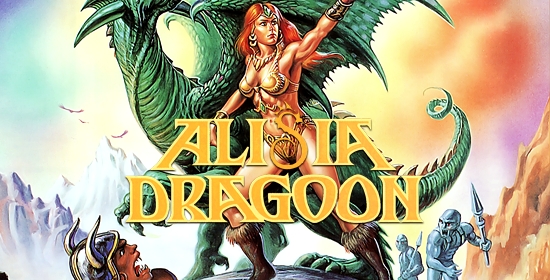
Originally known for the impossibly cool but virtually unplayable mess known as Thexder, Game Arts was already a pretty mature, but small, Japanese computer game developer when they released Alisia Dragoon (AD). A poor seller during its release period, AD practically oozes with solid competency. Add some innovative light RPG features sprinkled in to spice up the highly responsive action platformer formula and you end up with a really good game that's earned a well deserved cult following over the years. Like fine wine, it's only gotten better with time.

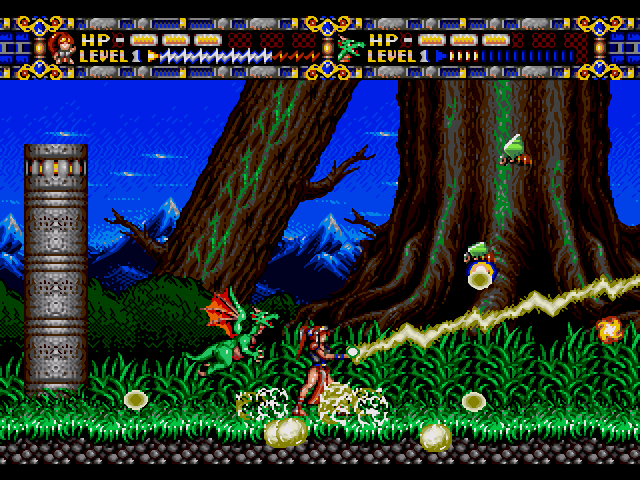
The basic gameplay in Alisia Dragoon is fairly typical for the genre, run around a level jumping from platform to platform, shoot at bad guys, survive until the end. Mechanically, there's not much new here. Yet, AD advances the formula in a few key ways that have earned it much love:

  • Your attack is an auto-targeting lightning attack.
  • Levels are fairly large and reward exploration with powerups and loads of secret areas.
  • You have an AI buddy (well actually four) that follow you around and assist.
  • Light RPG elements

Reminding me of Thexder's auto-targeting laser attack in robot mode, I was not surprised to find out the same developer worked on both games. This lightning attack made me think this game would be a breeze at first: face an enemy and push fire, no targeting or strategy. But AD balances out the seemingly overwhelming power of your attack in a few really well designed ways. First, you are practically overwhelmed with enemies, which forces you to pace your progression. Second, as the game advances they simply absorb more punishment, even powering up all the way doesn't completely remedy this. Third, the more intensely you use your attack the weaker it gets (reminiscent of The Legendary Axe on the TurboGrafx-16/PC Engine from a couple years before). You have to find a space to rest for a moment to recharge your attack. The late game really requires a surprising amount of nuanced strategy to make it through and can't really be appreciated till you're there (and have found yourself at a bitter end many times to learn your lessons).


The levels in AD are varied, interesting and just large enough to get a little lost in, but not so big that you can get lost in them. You never really wonder where to go as you wander around, yet they at least pretend to offer several choices as you work your way through them. Since there's no time-limit, it's worth taking the time to explore as you'll almost always find something valuable: a power-up, food, fairy helpers, etc. They're really well designed and you never feel like the game is being cheap or cheating.


AD introduces what may be one of the earlier AI controlled allies in a game. Often called "familiars" or "companions", AD let's the player select from one of four (or even none at all) friendly helpers creatures. Each helper has their own life bar and attack level (up to 3). The helper AIs each have different kinds of attacks and use-cases, from tossing boomerangs to unleashing a devastating screen clearing lighting attack. Cultivating your AIs is an important strategy element in the game.

The companions are interesting, and building them up and keeping them alive is definitely an interesting part of the game -- and they can be helpful. But I also kept wishing for them to be a little more...aggressive. There were plenty of times that I was being mercilessly beat upon only to have my dragon or ball of fire or whatever simply sit there and not do much of anything as I yelled at the screen "some friend you are!" Even with everybody all powered up, you never really reach the kind of havoc you wish you could unleash on the enemy. So they're really more of an enhancement than a core game-play mechanic. They're optional enough that I'm sure there's a group of AD players that simply turns the familiar off for a more hard-core game-play experience.

Graphics in Alisia Dragoon are generally very good. You'll see interesting characters in fascinating settings. The range from fantasy to techno alien. However, they have a flavor to them that's like nothing else on the system. I think that's because Game Arts really cut their teeth in the computer games market as well as most of the design work and graphics done by anime studio, Gainax, better known for computer dating sims when they do work on games.


It's almost like AD looks like a very good guess of what a computer games company thinks arcade style graphics on a console look like. It's like having a world class classically trained portrait painter draw a picture of Mario. It'll be beautiful, accurate, have sophisticated brush technique and treatment of lighting, but it won't really be the cartoon Mario everybody's used to seeing. In the same sense, the character designs in AD seem almost overworked and scream for a higher resolution screen to capture it all - they would definitely be more at home on a Japanese computer.

Music and sound effects are in many ways the same bag. Like nothing you've ever really heard on the console, but really well done. Perhaps then it won't come as a surprise that the music and sound engineering also was sub-contracted out to a company they worked with on other occasions Mecano Associates (also known for the music in Silpheed).

I'd rate the music in Alisia Dragoon a tad higher than the graphics. There's some really great music in the game. Stretching from Baroque harpsichord music to upbeat new age rock the music services and enhances each level well. The Genesis sound chip is bent in some pretty great ways to provide subtle reverb and echo effects, drum machine, orchestrations and organ leads that really sound fantastic. Sound effects are likewise well designed and get out of the way. You main attack sound never gets annoying, and various clumps, bumps and explosions are sound about as good as you'd expect. A few of the sound effects, namely an enemy teleportation effect, are simply awesome and really caught my attention the first couple times I'd heard it.


Gameplay in Alisia Dragoon is interesting. I kept finding I wanted to compare it to something else. And I think this is one of the reasons the game never really broke out on its own. For me the main game that kept coming up in my thoughts was Castlevania.

For many years Sega sought to produce a Castlevania clone for their systems. Master of Darkness for the Sega Master System is one early attempt. But none of them really quite caught the Konami magic. Despite different gameplay mechanics, the great music and fantasy setting really kept bringing me back to that conclusion however. A real Castlevania game wasn't to hit the system until two years later.


There's really not much else to say about Alisia Dragoon. It's an unbelievably solid and polished game, well worth playing. But it probably won't drive you histrionic with unbelievable levels of fandom. You'll be rewarded with about an hour long playthrough, some great music, some cool locations and interesting gameplay. If you beat it, you'll be rewarded with a pretty cool ending and one of the better songs in the soundtrack. It's kind of sad that AD doesn't have a bigger legacy. It's not even a virtual console game. Game Arts these days is too busy printing money with its Lunar games to really try and revive a pretty great game.


Further Reading

Thursday, October 3, 2013

Revenge of the 'Gator/Pinball: Revenge of the Gator/Pinball: 66 Hiki no Wani Daikoushin (ピンボール 66匹のワニ大行進) - Game Boy

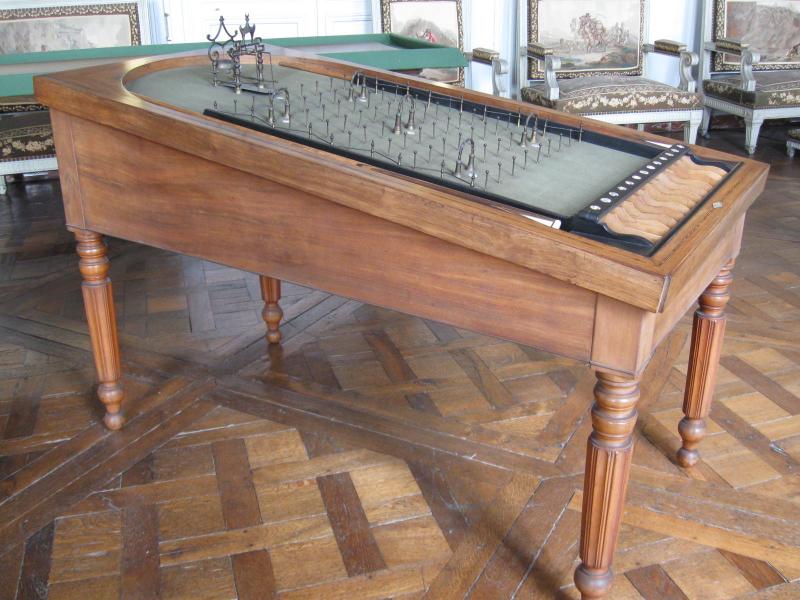
Pinball has a surprisingly long, complex, and sometimes seedy history. The progenitors of pinball started from a 17th century variant on various cue sports like billiards (which was itself a variant on the ancient game of bowling) played by the aristocratic class during the reign of the builder of the Palace of Versailles, the Sun King himself, Louis XIV. That's right, early versions of pinball probably filled the recreational areas of the absolute monarch of France.

Pinball's name derives from the historic source of these kinds of table bowling games. It turns out that knocking over tiny pins (a la Bowling) takes forever to set back up for another round. So some early game maker simply nailed the pins into the board, found that the little ball ricocheted nicely and put targets and holes and such around the playfield.


Eventually, the game was refined in different directions and spun out in a number of directions, two of which bagatelle and billard Japonais (Japanese billiards) are important today. Bagatelle remained a popular game and was even brought over by French soldiers to the U.S. during the American War for Independence and remained popular enough for Civil War era cartoons to feature it.


Examples of these games continued to find their way East and West until becoming Pachinko in Japan and Pinball in the U.S.

Okay, maybe not that simple, early games required people to roll the ball up, or hit it with a cue stick, and bounce off of the now embedded pins into scoring holes or targets. It was eventually found, circa 1770 that using a spring launcher to launch the ball to the top of the table and let gravity pull the ball down into a labyrinth of pins was more fun and voila! Pinball!

In the early 1930s coin-operated "pin games", often called "bagatelles", were introduced. The first major hit was Baffle Ball by David Gottlieb (lovingly recreated in Microsoft's Arcade Pinball). Other than the plunger, these were almost entirely games of chance. A shortage of "Baffle Balls" inspired a Gottlieb distributor who started making their own games, starting with "Ballyhoo" and eventually spun out to become Bally.

I remember as a kid watching what I thought was a bizarre game of pinball on the Honeymooners (The Jackie Gleason Show). In the episode, Two Men on a Horse, the main character Ralph attempts to win some quick money from a Pinball machine by drawing back the plunger, shooting the ball and then...nothing. No flippers or bumping the table or anything. The scene puzzled me for years.


It turns out flippers weren't introduced (Gottlieb's Humpty Dumpty) and made common until around the time of that episode. The familiar double flipper system, common to all modern pinball games, finally stuck with Gottlieb's Spot Bowler in 1950. And with that the basic format of modern pinball was set.

Additions since then, score keeping, bumpers, sounds, lights are all derivative of this basic system. Pinball machines eventually shed their gambling past with a virtuoso display of flipper skills in court and it opened the game up to play by people young and old for years.
The ban ended when Roger Sharpe (a star witness for the AMOA – Amusement and Music Operators Association) testified in April 1976 before a committee in a Manhattan courtroom that pinball games had become games of skill and were not games of chance, that is, gambling. He began to play one of two games set up in the courtroom, and – in a move he compares to Babe Ruth's home run in the 1932 World Series – called out precisely what he was going to shoot for, and then proceeded to do so. Astonished committee members reportedly voted to remove the ban, which was followed in other cities. (Sharpe reportedly acknowledges his courtroom shot was by sheer luck.)
At about the same time, it was realized that pinball could be simulated reasonably well with current game technology and video pinball was born. Versions of more or less faithful video pinball games started coming out for computers, arcades and home consoles and have continued on to smart phones and probably far into the future.

A early 1989/1990 release by HAL Laboratory for the Game Boy (and later 3DS and Virtual Console), Revenge of the 'Gator (RotG) is a classic on the platform. At first glance it seems like a basic enough, 'Gator themed pinball game for the portable. There's a couple of easily accessible levels on the playfield with some interesting targets and bumpers and such. A fun, light and upbeat tune plays on in the background. There's nothing amazing about RotG, but it's supremely competent at first glance. Good enough for casual play for a few minutes, but like any pinball game, deep enough for long play.


As you play, you soon realize that the targets are more than just point multipliers, hitting sets of them open up doors to new areas and turn on blockers to keep your ball from draining to a lower part of the field or down the final drain where it's eaten by a waiting, exaggerated cartoonish alligator.


Two more entire single screen playfields are reachable through these unlocked doors. Other paths lead to single screen bonus stages. And it's here that the designers went wild and had some fun. These other areas play really nothing like the traditional pinball we've come to know and love over the past several decades. Sure there's flippers, but the playfields combine bits of breakout and whack-a-mole with flying baby alligators and other madness. They're fun and a nice reward for climbing the screens that far.


Play-wise, there's some interesting design decisions. Lots of modern pinball games have an elevated track, that's not here. Nor is multiball, bumping the table, or other various themes common to modern pinball. In many ways it feels like a pinball game from the early pre-digital years. The game never really elevates to the kind of panicked frenzy that lots of modern games bring you to. This is really a game you can pick up quickly, play a few relaxing rounds, then put down.

The screen also doesn't scroll, which, while initially alarming, surprisingly helps the game be more playable on the Game Boy's blurry screen. Ball physics are pretty good, with some time you can get a feel for the ball and usually get it to go where you want after a couple hits. One frustration, certain targets reset if you go off that playfield, meaning that a long effort to unlock a door can end with a momentary dip to a lower part of the game.

There's a few songs, a title song, a main playfield song and one for bonus rounds. They all sit comfortably in the background without becoming annoying -- though there's no way to turn it off. Sound effects are well designed and distinct, with different kinds of targets giving appropriate sounds.

Graphics are pretty good for the such an early release and hold up well even to games later in the system's life, and quite frankly even against more modern, colorful games. The art direction has kept the game fresh feeling, and the decision to go with 'gators means the green screen of the Game Boy has meaning.

I think Game Boy Crammer has a good take on the game.

Revenge of the 'Gator is a fun game, it's not the best game, but it's a fun diversion for a bit. The extra play areas and bonus stages means that long play, and investing some time into the game are rewarded. You'll probably see everything there is to see in the game after no more than 5-10 hours of game play, but that's okay -- It's pinball.